
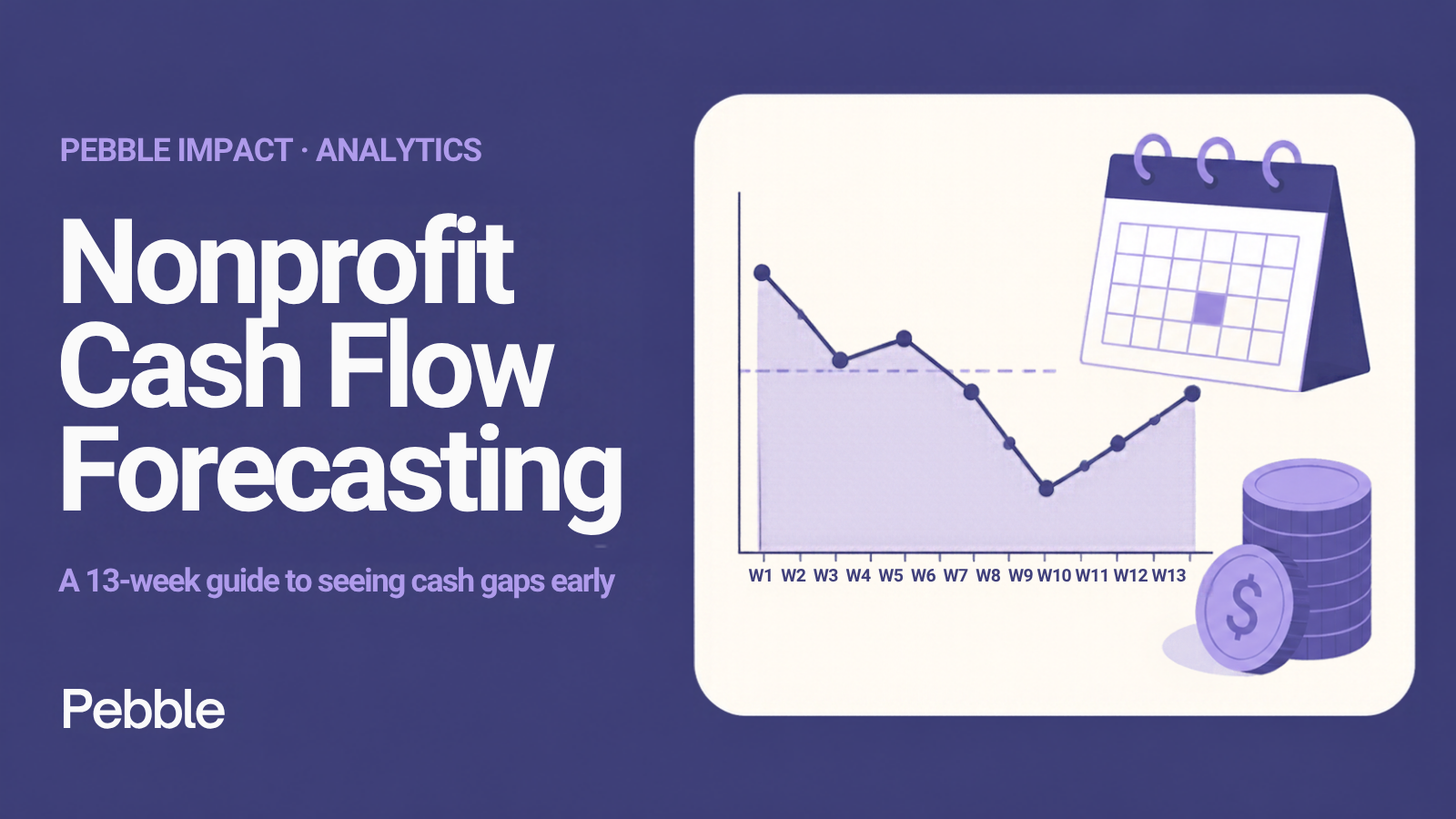
Nonprofit cash flow forecasting is how finance teams see a cash crunch weeks before it lands, instead of discovering it the morning payroll is due. Your Statement of Activities can show a healthy surplus while your bank account runs dry, because grant revenue gets recognized long before the reimbursement check clears.
That gap matters more than ever heading into year-end. Below, we break down what a cash flow forecast is, how to build a rolling 13-week version, which numbers to watch, and how to turn the forecast into decisions your ED and board can act on.
What is nonprofit cash flow forecasting?
Nonprofit cash flow forecasting is the practice of projecting the actual cash that will move in and out of your bank accounts over a defined period, usually week by week. It maps expected receipts (grant draws, reimbursements, pledges, earned revenue) against disbursements (payroll, rent, vendors, debt) so you can spot shortfalls early and act before they become emergencies.
In one line: a cash flow forecast tells you how much money you will have in the bank, and when, so you can plan around timing rather than react to it.
It is different from your operating budget. A budget answers "what will we earn and spend this year?" A cash forecast answers "will we have enough cash on the 15th?" Both matter, but only one keeps the lights on during a reimbursement delay.
Why does cash flow forecasting matter so much for nonprofits right now?
Cash forecasting matters because many nonprofits operate with thin reserves and unpredictable receipt timing. When over half of organizations hold three months of cash or less, a single delayed government payment or late major gift can force hard choices about payroll, programs, or a line of credit. A forecast turns that risk into a visible, manageable number.
The data is sobering:
- Per the Nonprofit Finance Fund's 2025 State of the Nonprofit Sector Survey, 52% of nonprofits have three months or less of cash on hand, and 18% have one month or less.
- The same NFF 2025 survey found 36% of nonprofits ended 2024 with an operating deficit, the highest in ten years of NFF data.
- According to Urban Institute research reported by the Chronicle of Philanthropy (2025), about one-third of nonprofit service providers saw a government funding disruption in the first half of 2025, including 27% that faced delays or funding freezes.
When reserves are short and timing is uncertain, the forecast becomes your early warning system. It is also what your auditor and board increasingly expect: under FASB ASU 2016-14, nonprofits must disclose how they manage liquid resources to meet cash needs for general expenditures within one year of the balance sheet date.
How do you build a 13-week cash flow forecast for a nonprofit?
Build a 13-week forecast by starting with today's actual bank balance, listing every expected receipt and disbursement by week, and calculating the projected ending balance for each week. Thirteen weeks covers a full quarter, which is long enough to see reimbursement cycles and short enough to stay accurate. Update it weekly against actuals.
- Start with real cash. Use your reconciled bank balance across operating accounts, not book balances. Separate restricted cash if donor or grant terms require it.
- List receipts by expected arrival date, not award date. Grant drawdowns, cost-reimbursement payments, pledge payments, program fees, and event revenue each have their own timing. Use history: if a state agency typically pays 45 days after invoicing, forecast 45 days.
- List disbursements by due date. Payroll and benefits (your largest, least flexible outflow), rent, insurance, vendor payments, loan payments, and planned capital purchases.
- Calculate weekly net cash flow and ending balance. Beginning cash + receipts − disbursements = ending cash, which becomes next week's beginning cash.
- Set a minimum cash floor. Define the lowest balance you will tolerate (for example, two payroll cycles). Flag any week that dips below it.
- Roll it forward weekly. Drop the past week, add a new week 13, and compare forecast to actual. Variances teach you which assumptions to fix.
For the longer horizon, pair your 13-week view with a monthly 12-month projection tied to your rolling forecasts and scenario plans.
How do grant reimbursements affect nonprofit cash flow?
Cost-reimbursement grants require you to spend first and get paid later, so every dollar of program activity is effectively a short-term loan from your own reserves. The larger your share of reimbursement-based funding, the more working capital you need, and the more precisely you must forecast the lag between spending and receipt.
- Know the rules. Under OMB Uniform Guidance (2 CFR 200.305), federal agencies generally must pay reimbursement requests within 30 calendar days of receiving a proper request. Pass-through entities and state agencies often run slower, so forecast based on observed history, not the rule.
- Bill on a fixed cadence. Submitting reimbursement requests monthly (or more often where allowed) shortens the cash gap. Late invoicing is a self-inflicted delay.
- Track receivables by funder. Aging reports reveal which funders pay slowly. Our guide to AR turnover ratio shows how to measure this.
- Forecast restricted cash separately. Cash received in advance for a restricted purpose is not available for general operations. See our breakdown of donor-restricted funds for how to keep it straight.
What metrics should you track alongside a cash flow forecast?
Track a small set of liquidity metrics that translate the forecast into decisions: days cash on hand, months of operating reserves, the lowest projected balance in the forecast window, receivables aging, and forecast accuracy. Together they show how much cushion you have, where pressure is coming from, and whether your projections can be trusted.
- Days cash on hand: unrestricted cash ÷ (annual operating expenses excluding depreciation ÷ 365). A quick read on how long you could operate with no new receipts.
- Months of operating reserves / runway: how long unrestricted liquid assets would cover expenses. Our post on the survival ratio and runway covers the math.
- Lowest projected balance (cash trough): the single weakest week in your 13-week view and how far it sits above your floor.
- Receivables aging: grant and pledge receivables over 30, 60, and 90 days, by funder.
- Forecast accuracy: projected vs actual ending cash each week. Consistent misses point to bad timing assumptions, the same discipline used in budget vs actual variance analysis.
What should you do when the forecast shows a cash shortfall?
When the forecast shows a shortfall, act on timing first and spending second. Accelerate receipts, adjust the timing of discretionary payments, and line up a credit facility before you need it. Because a 13-week forecast surfaces the problem weeks in advance, you can choose measured options instead of emergency cuts.
Levers to pull, in order
- Accelerate inflows: submit pending reimbursement requests, follow up on overdue receivables, ask pledgors about timing, and request advance payments where funder terms allow.
- Re-time outflows: shift non-critical purchases, negotiate vendor terms, and stage capital spending. Never delay payroll taxes.
- Secure bridge capacity: establish a line of credit or bridge loan while finances look healthy. Lenders are far more receptive before a crisis.
- Escalate early: brief the ED and finance committee as soon as the trough breaches your floor, with options and a recommendation.
What are the most common nonprofit cash flow forecasting mistakes?
The most common mistakes are forecasting from the budget instead of the bank, assuming funders pay on time, ignoring restrictions, and building the forecast once rather than updating it weekly. Each one creates false comfort. The fix is simple in principle: use actual cash, historical payment timing, and a disciplined weekly refresh.
- Mistake: using award or budget dates for receipts. Fix: forecast by when cash actually arrives, using each funder's payment history.
- Mistake: treating all cash as available. Fix: carve out restricted and advance-funded cash so you see true operating liquidity.
- Mistake: a static spreadsheet built once a year. Fix: roll the 13-week forecast forward every week and reconcile to actuals.
- Mistake: forgetting lumpy outflows. Fix: calendar three-payroll months, annual insurance premiums, audit fees, and year-end bonuses.
- Mistake: keeping the forecast in the finance office. Fix: share a simple cash view in every board financial report so leadership sees timing risk early.
How Pebble Impact helps with nonprofit cash flow forecasting
Most cash forecasts break down because the inputs live in different places: the GL in one system, grant budgets in spreadsheets, and reimbursement status in someone's inbox. Pebble brings those together with integrated, real-time metrics, so liquidity indicators like cash runway, receivables aging, and budget vs actual update from your accounting data rather than a monthly copy-paste. Post-award grant management tracks spend, drawdowns, and remaining balances by award, which makes reimbursement timing and restricted cash far easier to forecast.
When it is time to communicate, Reporting Studio turns those numbers into board-ready and funder-ready reports without rebuilding them each month, and compliance tracking keeps grant terms visible alongside the dollars. Explore Pebble's operating analytics and grant performance tracking to see how it fits your forecasting process.
Frequently Asked Questions
How far ahead should a nonprofit forecast cash flow?
Most nonprofits benefit from two views: a weekly 13-week forecast for operational decisions and a monthly 12-month projection for planning. The 13-week view captures payroll cycles and reimbursement lags precisely, while the 12-month view shows seasonal patterns such as year-end giving and fiscal-year grant renewals.
What is the difference between a cash flow forecast and a budget?
A budget projects revenue and expenses over a year, often on an accrual basis, to show whether operations break even. A cash flow forecast projects when money actually enters and leaves your bank account. You can be on budget and still run short of cash if receipts arrive later than expenses are paid.
How much cash should a nonprofit keep on hand?
There is no single standard, but many nonprofits target three to six months of operating expenses in unrestricted reserves, set by board policy. Organizations heavily reliant on cost-reimbursement grants usually need more working capital because they spend before they are paid.
Should restricted cash be included in a cash flow forecast?
Yes, but show it separately. Restricted cash can only be used for its designated purpose, so mixing it with operating cash overstates your liquidity. A good forecast shows total cash, restricted cash, and available operating cash so leadership sees what is truly spendable.
How often should the forecast be updated?
Update a 13-week forecast weekly. Each week, replace the prior week's projection with actual results, roll a new week onto the end, and revisit any assumptions that missed. A forecast refreshed monthly or quarterly quickly loses the precision that makes it useful.
Can software automate nonprofit cash flow forecasting?
Software can automate the most time-consuming parts: pulling actuals from the general ledger, tracking grant spend and reimbursements, and refreshing liquidity metrics. Finance staff still own the judgment calls, such as funder payment timing and which payments to re-time, but automation frees time for analysis instead of data gathering.
Ready to see cash trouble coming weeks in advance? Pebble connects your accounting, grants, and budgets into real-time liquidity insights your team and board can act on — request a demo.


